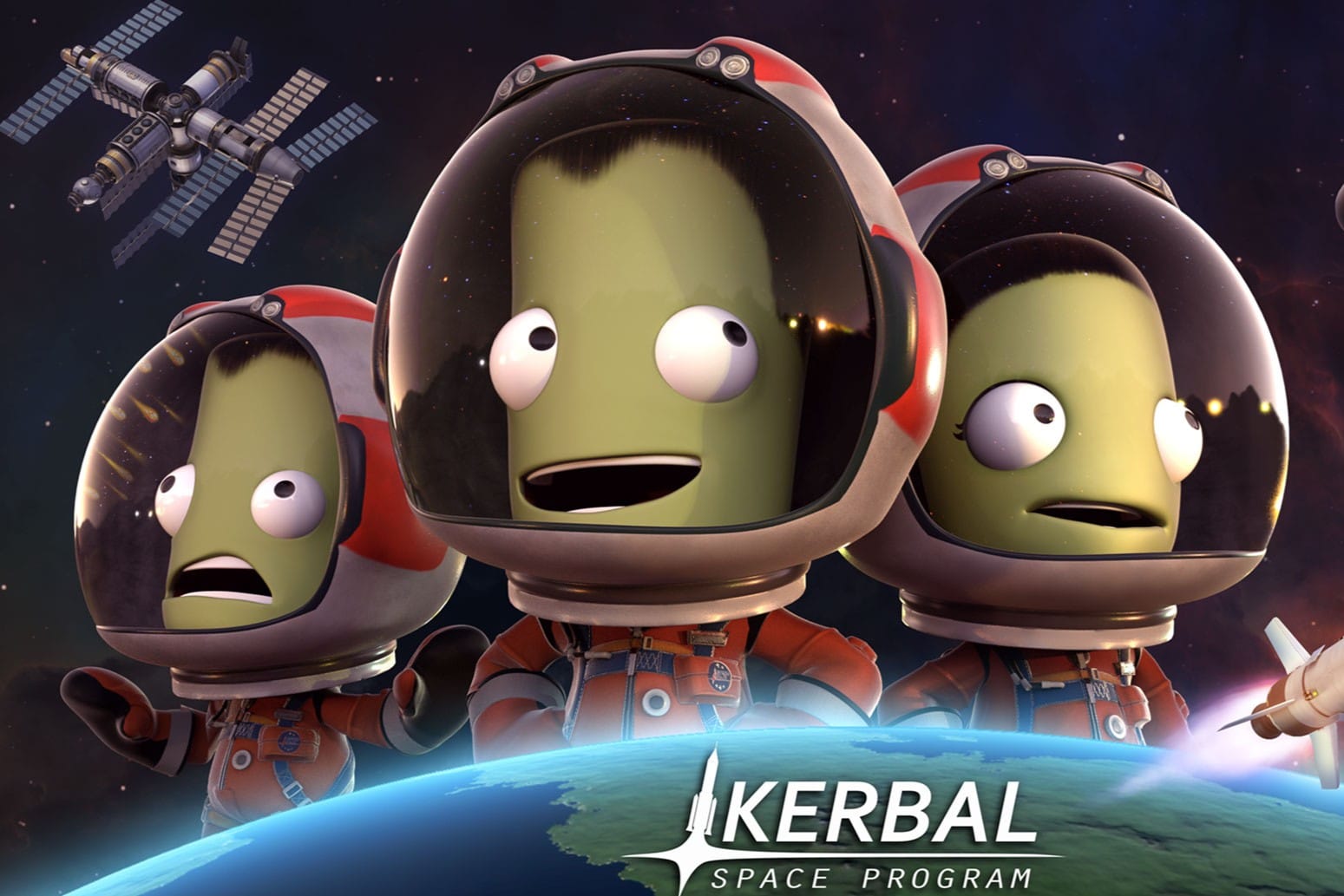
Getting started in Kerbal Space Program (KSP) can be both exciting and challenging. With so many parts, engines, tanks and other components, building your first rocket can seem difficult. We have gathered some tips to help you build rockets better and understand how different components work and avoid some of the most common mistakes.
Essential Terminology to Understand Kerbal Space Program
Before entering the building stage in Kerbal Space Program there are some technical terms you need to get familiarised with. Knowing this vocabulary will help you understand the game mechanics much better.
Indispensable terminology to play KSP
- Delta-V: Refers to the total change in velocity that a spacecraft can achieve using its available fuel. It is one of the most important measurements in KSP. It helps determine whether a rocket has enough performance to complete a mission.
- Thrust-to-Weight Ratio (TWR): The relationship between the thrust produced by a rocket’s engines and the rocket’s weight. A TWR above 1 means you can accelerate upwards against gravity, below 1 means it cannot lift off.
- Staging: The process of dividing a rocket into separate sections that can be activated during flight.
- Decoupling: The separation of one rocket section from another, usually through the activation of a decoupler.
- Low Kerbin Orbit (LKO): A low orbit around Kerbin, the planet where the game begins. Commonly used as a starting point for missions.
- Periapsis: the lowest point of an orbit around a celestial body. The highest point of an orbit around a celestial body.
- Orbital insertion: the manoeuvre used to establish a stable orbit around a celestial body.
- Transfer orbit: an orbit a trajectory used to travel from one orbit to another, such as travelling from Kerbin to the Mun.
- Gravity assist: a technique that uses the gravitational influence of a celestial body to change a spacecraft’s velocity and direction.
The Building Stage in Kerbal Space Program
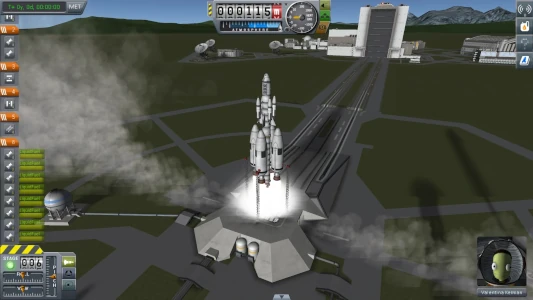
In Kerbal Space Program (KSP), you build rockets by connecting individual pieces of a spaceship. Each component serves a particular purpose. Not every component on the list is essential. Some are necessary for a rocket to function, while others are optional for some missions. If you are playing as a beginner, start from the basics. use a command pod, fuel tank, an engine and a parachute.
Once you start to understand the components and how they work together, you can introduce additional parts.
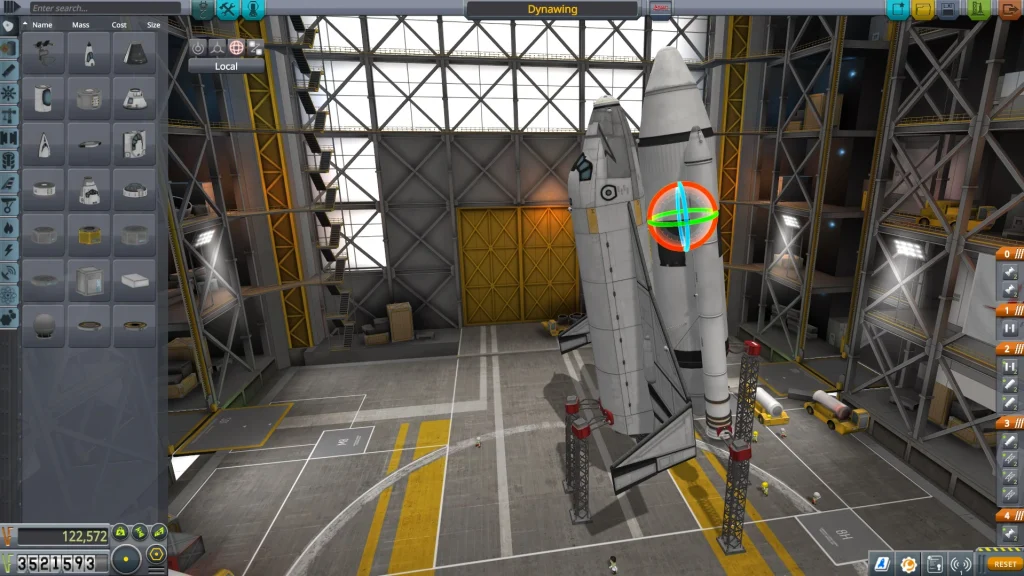
Spacecraft parts in KSP
- The Command Pod: this is the control centre of your spacecraft. Here will be where your Kerbal astronauts sit. This component allows you to control and steer the rocket during flight. It is essential for crewed missions. In an unmanned mission, you can replace it with an unmanned probe.
- Fuel Tanks: here is where the propellant for your rocket is stored.The amount of fuel determines how long your engines can operate and how much delta-v your rocket can generate. These are necessary for most conventional rockets. Although some engines, such as solid rocket boosters, contain their own propellant.
- Engines: these generate the thrust that pushes your rockets upwards. Different engines have different characteristics. They are essential for powered flight.
- Decouplers: These connect different sections of a rocket and allow them to separate during flight.These are useful for multistage rockets but are not essential for single-stage rockets.
- Fins: Aerodynamic components usually attached near the bottom of the rocket. Fins improve stability during atmospheric flight, helping the rocket maintain its direction and reducing unwanted movements.
- Parachutes: used to slow down a spacecraft when it returns through the atmosphere. They are very useful for recovering astronauts and spacecraft. Parachutes are optional if you use alternative landing methods.
- Science equipment: these components allow you to collect scientific information during missions. This equipment helps you earn science points and unlock new technologies in science and career modes.
Tips for building in Kerbal Space Program
Start From Simple Models
If it’s your first time trying KSP, do not go for the big and complicated rocket. Start with the command pod, parachutes, a fuel tank and an engine. Keep your rocket tall and relatively narrow to reduce air resistance.Keep your rocket tall and narrow to reduce resistance. Avoid unnecessary parts. Build the payload first and design the rocket around it.
Balance Is The Key
One of the keys to rocket building is symmetry. Make sure to add identical boosters to both sides of your rocket. Try to distribute the weight evenly around the centre of your rocket and avoid placing heavy parts on just one side. An unbalanced rocket will lean in one direction during flight. This will make it much harder to control it.
The Right Engines And Fuel Tanks
In KSP you’ll mainly work with liquid-fuel engines and solid rocket boosters. It’s important to understand how each one of them works when building your rocket. Liquid-fuel engines need compatible fuel tanks to operate. Solid boosters are self-contained and come with their own propellant. You can’t use a solid booster to power a separate liquid-fuel tank.
Build With Staging In Mind
Staging is one of the most important mechanics in Kerbal Space Program, as it allows you to control the different stages of your rocket during flight. Each stage triggers a specific action when you press the Spacebar, such as activating an engine, separating boosters and deploying a parachute.
Before every launch, take a moment to check your staging sequence in the Vehicle Assembly Building. Making sure everything is in the correct order can save you from unexpected surprises and prevent disaster.

Ready For Launch? Your Journey To The Stars Starts Here
Kerbal Space Program is a great choice if you are interested in space exploration. Although many players were looking forward to KSP 2, its development was unfortunately discontinued before it could reach its full potential. What was released was an early access version, what makes the first title the best place to start and still a great video game to enjoy today.
KSP can also be enjoyed as a multiplayer with friends through community mods. Working together to build rockets, exploring the star system and planning missions!
Join our community of gamers and gather your new crew of astronauts. Share spacecraft building tips and stay tuned for more guides and curiosities.
Game on!🚀
- Sea Salt & Paper: The Ultimate Guide to Winning Every Round
- Tips for Building in Kerbal Space Program
- One Piece Card Game Guide: Learn to Play from Scratch

- 5 Silly Multiplayer Games For Your Newly Formed Gamers Group

- Is GTA 6 Eligible for Game of the Year 2026?

- Best Star Trek TNG Board Games and Where to find Them