PlayStation published an update that after consideration they have made the difficult decision to step away from collaborating with Kojima Productions on its project Physint. This news comes at a time when Hideo Kojima himself has been critical of PlayStation’s decision to move away from physical formats for its games.
PlayStation Steps away from Kojima Productions
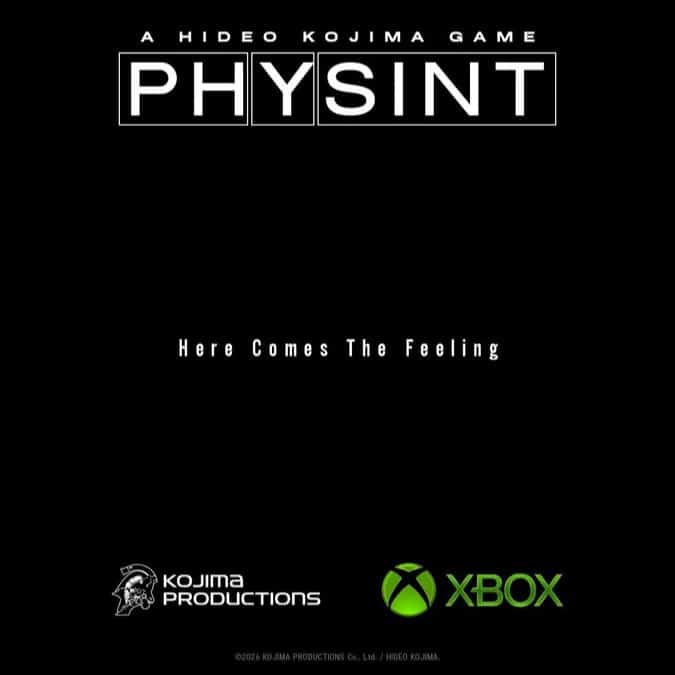
On the 10th of September 2026, Play Station communicated via X that they have made the decision to step away from Kojima Productions on its project Physint. Minutes later, Hideo Kojima confirmed the decision on his X account. Determined to keep the project alive, the production studio reached out to find a partner and found XBOX. Kojima states that both the studio and XBOX share a common vision for the future.
This new collaboration arrives after the declarations of Koojima about the current state of gaming, the decision of PlayStation to move from physical formats, and what it actually means to buy and own a video game.
The decision by Kojima Studios and PlayStation to go their separate ways is not the first consequence following the announcement of the company’s future plans.
Movimiento Ciudadano Against PlayStation
Movimiento Ciudadano in Mexico has joined the chorus of voices opposing PlayStation’s plan to digitise its games. In a video posted on Instagram, they have criticised the company and highlighted the importance of physical formats in video games.
Senator Luis Donaldo Colosio and MP Iraís Reyes lodged a complaint with the National Antitrust Commission against Sony Interactive Entertainment on the 4th of August. Senator and MP registered a complaint with the National Antitrust Commission against Sony Interactive Entertainment on 4 August. Both maintain that PlayStation’s decision to stop producing games in physical format will have consequences for the Mexican market and consumers. They argue that the reduction in purchasing options will affect both businesses and consumers.
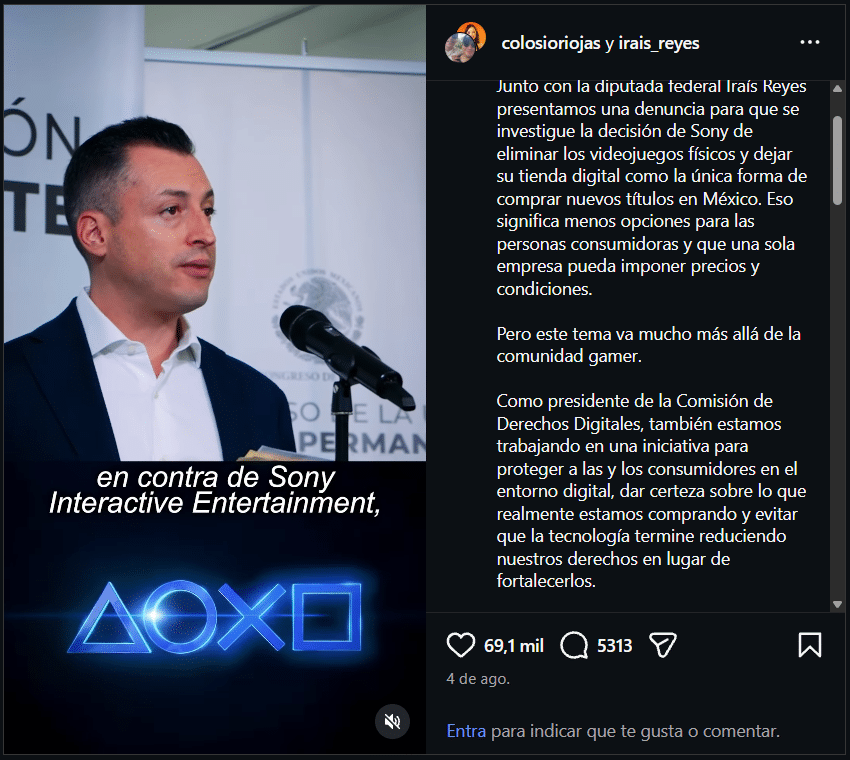
For non-spanish speakers, here is the translation of the video:
We filed a formal complaint against Sony Interactive Entertainment, the company behind PlayStation. Because we are seeing the impact of people’s economic rights in the digital environment. On July 1, Sony announced that from January 2028 it would stop producing physical video games for all its consoles. We assess what this entails.
From 2028 the only option will be the Sony store, at the price that Sony decides. Under the conditions that Sony imposes and without the possibility of reselling, lending, exchanging or passing on what you bought. Sony is controlling the hardware, it is controlling the gentrification of games, it is controlling the digital store and now it would be eliminating the only channel in which there was competition. The physical format. And the consequences could mean higher prices for consumers. The disappearance of stores and jobs in the retail sector and the destruction of the second-hand market that today allows millions of players to access titles at an affordable price.
And, for this reason, also as president of the Digital Rights Commission (Comisión de Derechos Digitales), I raise my voice. The report is the first step. That is why we are working on a draft bill to regulate digital property and protect consumer rights in the digital environment. What we are looking for is for the law to clearly define what type of property you are acquiring when you make a digital purchase. And that it is guaranteed that if you paid for a product, that product will continue to work even if the company decides to close its servers.
Not the First Lawsuit Against PlayStation
Back in July, four customers sued Sony, claiming that the information provided by the PlayStation Store did not fully comply with section (b) (1) of the California Law about digital ownership. This section stipulates that the seller of a digital good who advertises the acquisition of said digital good as “buy” or “purchase” is selling it with an unrestricted ownership . If the purchase were to be of a time limited licence, the seller must provide the complete information. Along with a complete list of restrictions and conditions of the licence.
This information must be provided to the consumer (gamer) before completing the transaction a clear statement of said terms.
Sony argues that it provides access to its terms of service and software products. These make it clear that it grants licences for its digital products, not ownership.
1.4 The License to you
The Software is licensed to you, not sold. You are granted a limited, non-exclusive, non-transferable, and personal license to play or use the Software for your private, non-commercial use on the system or device it was intended for. This license is only effective from the indicated Software release date, early access date, or beta release date. Any rights in the Software that we do not say are granted to you in this license are reserved, including all intellectual property in the Software.
Section 1.4 The License to you, in PlayStation® Software Application End User License Agreement (“Software Terms”)
Mexico Takes Action Where the EU Doesn’t
Last July, EU Commissioner Michael McGrath stated that the EU cannot intervene in Sony’s decision to offer its games on an entirely digital catalogue. He maintains that this is a matter of commercial and contractual freedoms. He adds that companies are free to offer games and services in whatever way they see fit, provided that consumers’ rights are protected in accordance with national and EU legislation.
Let’s take a look at the EU online consumer rights:
- Right to Information: Online sellers must provide clear information about the product or service, including its price, shipping costs, and delivery time.
- Right to Cancel: online shoppers have the right to cancel online purchases within 14 days of receiving the goods, for any reason, and get a full refund.
- Transparency: Online marketplaces must indicate whether a seller is a trader or a private individual, as consumer protection laws apply only when buying from traders.
Source: e-Commerce rules in the EU, European Commission.
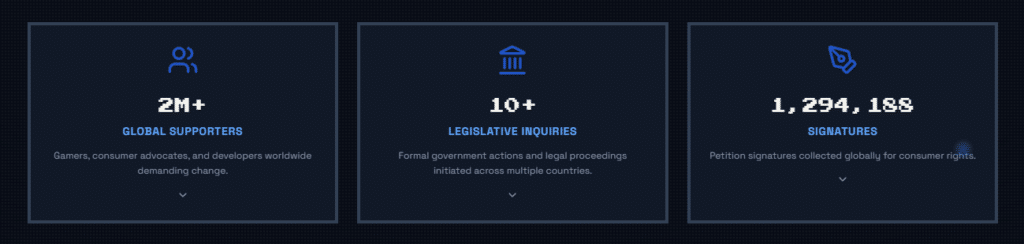
Meanwhile, the consumer’s rights campaign Stop Killing Games is pushing the European Union to require publishers to keep their games playable in the long term With over one million signatures online. Along with support from well-known influencers and politicians, such as Nicolae Ștefănuță (Vice President of the European Parliament) and Nils Ušakovs (European Parliament committee vice-president).
A reflection on physical video games
Physical video games have played an important role in making gaming culture accessible to the general public, regardless of a player’s financial circumstances. In physical format, a video game can be kept, reaches a wider audience, is passed down, lent out and resold. Sales of physical games have declined in recent years in favour of digital formats, due to the convenience of instant downloads, subscriptions and the rise of e-commerce.
But that does not make it any more accessible. The gaming community that was built up by lending games, inheriting them from friends or family, or buying them second-hand will disappear without the physical format.
Not only that, but the lifespan of a video game, which might be preserved as a vintage title or because a player wishes to relive an experience, will come to an end if we rely solely on a digital format that is dependent on user activity or the game’s popularity.
Video games are culture, eliminating purchasing and acquisition formats, and restricting the group of users reached by that culture, is to distance that culture from the general public.
Join us and become part of a community of gamers where you can connect with others, share experiences, play together and enjoy every game.
Game on!
- Dressmaker, The Fashion Game that’s Conquering the Internet
- One Piece Escape from Egghead, A Strawhat Adventure
- The Sift, The New Dimension in Minecraft Dungeons II

- Microsoft Files a patent to insert Ads while you play

- Thomas Spitze’s Coal Trilogy For History Enthusiasts
- Frosthaven 1.0 Video Game adaptation of the Popular RPG Board Game