A new patent registered by Microsoft Technology Licensing in April this year describes a system that could allow ads to be inserted in video games. The patent outlines technology for placing ads within virtual environments. The patent outlines that this advertising content will adapt to the game world and the player’s experience.
The filing of the patent does not necessarily mean that the technology will make its way into a commercial product. However, the filing has raised questions about how in-game advertising will evolve.
Microsoft Defines The Future Of Advertisements In Videogames
The patent was filed under the publication number US 2026/0260258 A1 titled Contextually Aware Management Of Interactive Software Application Access. Technology that could insert advertising content during pauses, transition screens or before and after cutscenes.
“A content management system may obtain a promoted content trigger event from an interactive software application based at least partially on content of the interactive software application.”
一 Abstract, Page 1, CONTEXTUALLY AWARE MANAGEMENT OF INTERACTIVE SOFTWARE APPLICATION ACCESS.
This advertising “spots” would vary depending on the video game. Once the system detects an appropriate signal, it could pause the game and display either a video advertisement or a static ad. After this, the video game would continue to monitor the player’s avatar for the next eligible window for the next ad. The background statement for this patent begins with an affirmation that inserting promotional content into video games is an action that can be done. By placing this promotional content through periodic breaks in the video game.
“In non-interactive audiovisual content such periodic breaks can be placed at a variety of predictable times in the content without adversely affecting the user experience.”
一 Background, [0003], Page 9, CONTEXTUALLY AWARE MANAGEMENT OF INTERACTIVE SOFTWARE APPLICATION ACCESS.
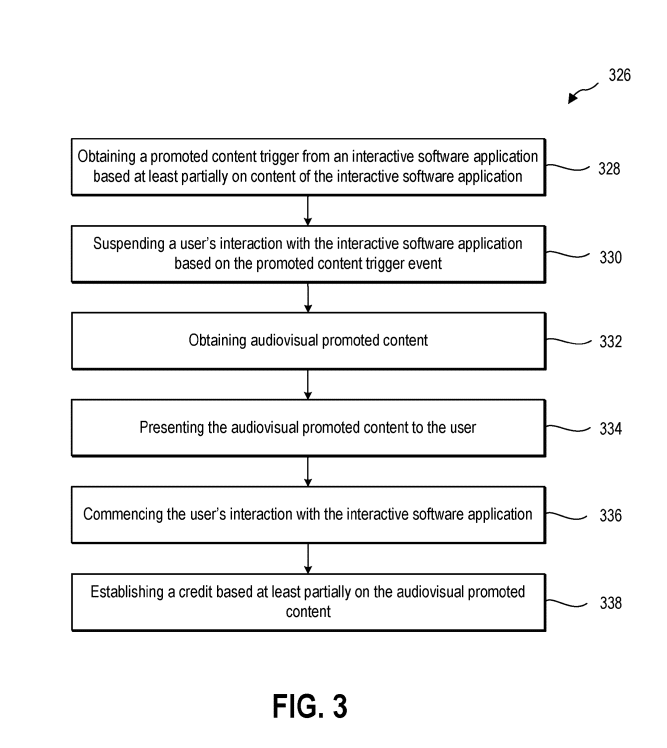
Microsoft’s new patent points out the situations in which players would encounter an ad
These affirmations place ad content in predictable spaces and timing. However, in the same paragraph, three lines below it states that other “varied user experiences” may make it challenging to identify when to suspend the action.
During the display of promotional content (ads) the videogame may be paused to prevent other events, actions or threats to occur to the player’s character. However the example given in the patent is no less reassuring. As this example explains, if the user is playing a racing game, the game will be paused so their car does not crash. This example features an interactive action or task during the game. Not a display of an ad between scenes, or cut scenes.
“Promoted audiovisual information may be presented to a user to allow the user to earn credits for the use of the interactive software application. […] During the presentation of the audiovisual information, the interactive software application may be paused, or constrained at the operating system level to prevent interaction with the interactive software application by the user to prevent events occurring in the interactive software application while the user is presented the promoted audiovisual information.”
一 Detailed description, [0022], page 10, CONTEXTUALLY AWARE MANAGEMENT OF INTERACTIVE SOFTWARE APPLICATION ACCESS.
Ads may also be triggered outside cutscenes and/or transitions. In the following example featured in paragraph [0023], it states that this promoted information could also appear when the character is in a safe location or context. Such as a team base or hideout.
“In some examples, user inputs to the interactive software application are pàused, suspended, interrupted, or otherwise prevented while the software application remains active. […] when the context of the interactive software application indicates adverse occurrences are unlikely or not possible to occur.”
一 Detailed description, [0023], page 10, CONTEXTUALLY AWARE MANAGEMENT OF INTERACTIVE SOFTWARE APPLICATION ACCESS.
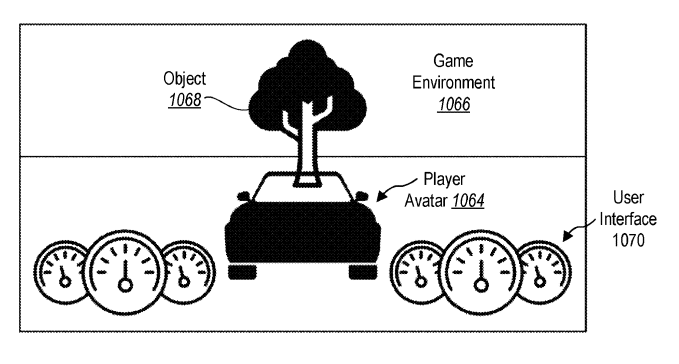
How Ads Would Be Seen During A Gaming Session
To be more precise in the paragraph [0041] details the different situations in which the model of this technology would “suspend” the interaction with the video game:
- Suspending the user’s interaction with the game includes pausing the game. However, in some instances the game continues running even during a pause screen or dialog box active.
- Suspending the user’s interaction includes constraining the game, such as stopping the execution of the game while retaining the application in memory. And allowing a rapid resuming after the visualisation of the advertisement.
- Limiting and/or preventing user inputs from being transmitted to or received by the interactive software application.
The Ads Microsoft Could Show
The content of the ads described in the patent would reach a broad range of promoted content. This includes announcements, alerts, and other audiovisual information that may be relevant or of interest to the plate. This could include video advertisements, static images, promotional messages, or other branded content during gameplay.
❗But, the patent does not limit the system to traditional commercials. This means that the technology could potentially be used for different types of promotional material depending on the game and the context in which the ad is shown.
What’s in it for the players?
The patent describes a credit system where a player earns or receives a certain amount of credits. While the credit is active, the game can remain free from another advertising interruption for a specific amount of time or gameplay. Once the credit expires, the system can wait for another appropriate point in the game to display promotional content.
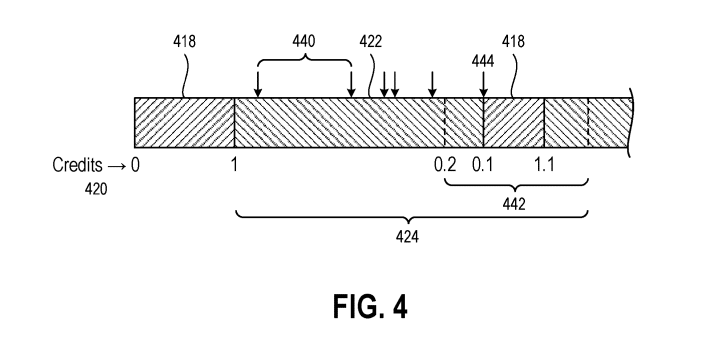
Following the information filed in the patent this mechanism could work in two main ways:
- Time-Based: An ad credit could last for a determined amount of time. For example: 15 minutes, 30 minutes, or longer.
- Gameplay-based: An ad credit with a preset goal, milestone or achievement. For example, completing certain rounds, finishing a level, or finishing a task or project.
In other words, ad credits would work as an ad-free allowance. Once you visualise one, the technology will track the duration and effectiveness of set credit until it expires. It is also important to note that not every game will necessarily use these exact triggers. These are descriptions of possible implementations covered by the patent.
This technology new patent is likely to be used primarily in free-to-play games across Xbox consoles, PC, and Xbox Cloud Gaming. The patent appears to support Microsoft’s efforts to explore ad-supported options for Xbox Cloud Gaming and free-to-play titles. Even so, advertising in games remains a sensitive issue among players that are already playing for the game pass to access those free to play titles. Particularly, as publishers continue to introduce new forms of monetisation.
❗While the technology described may initially focus its action on free-to-play titles, it could eventually make its way into paid games as well.
Join our gaming community for the latest news, guides, reviews, and everything video games and board games.
Game on!🎮
- EA Closes BioWare and Revives Fight Night after 15 Years

- ARC Raiders PvE Beta Test, Is it the end of PvP?
- Warhammer: Age of Sigmar – Spearhead, Preparing for Battle
- Squadron 42 Now Has A Steam Page And A New Trailer
- Invokyr A Video Game about a Forgotten Board Game
- Dressmaker, The Fashion Game that’s Conquering the Internet