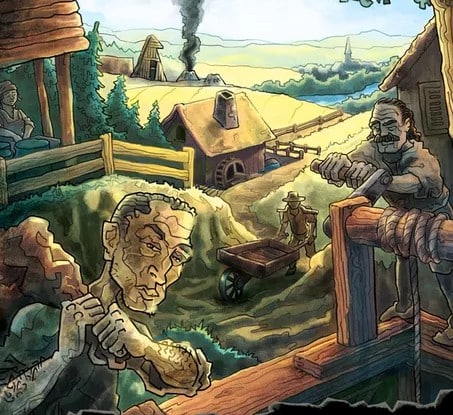
Maps are an essential part of every Dungeons and dragons campaign. They help bring your world to life, give players a sense of place, and make encounters easier to visualise and run. Following our series on DnD for newbies, here is our guide on how to make your own D&D maps.
Maps in Dungeons and Dragons: Learn the Basics
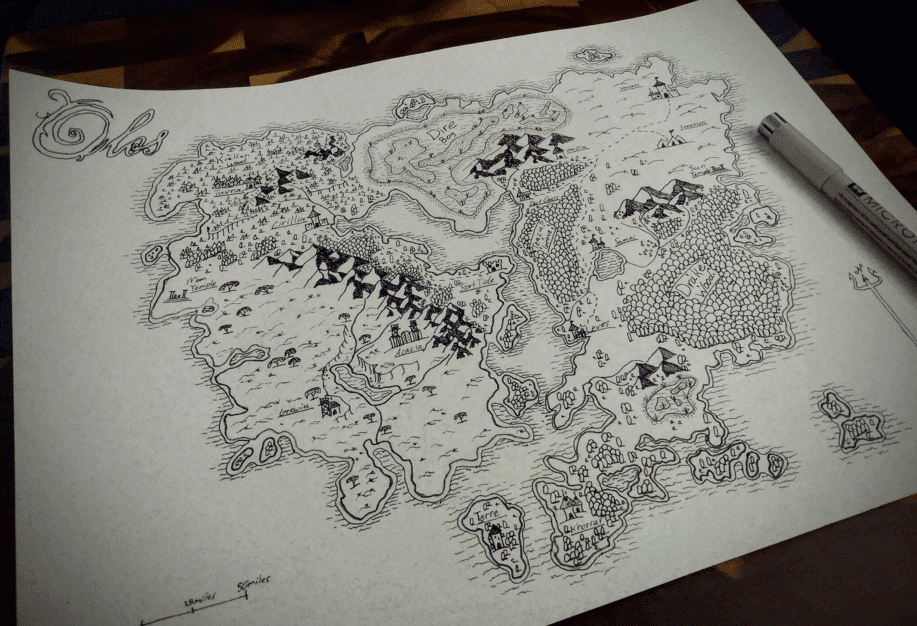
Before jumping to the drawing phase, there are a few basics you’ll need to consider. In Dungeons & Dragons, maps can serve several purposes. They can act as a prop for the party, help them navigate the world or city they are in. Maps can also provide clues on where to explore and investigate. And lastly, the map you sure have seen more, as a fighting ground.
Define the purpose for your D&D Maps
- Contextual and political purpose: In maps of the region, the wilderness area, or cities, players can understand the bigger picture of the game world. These maps can also show important landmarks, and are also useful for campaigns involving travel, diplomacy, war, or political conflict. Your players can find a map of the region or the next kingdom they are traveling to inside a crate, in the villain’s abandoned castle or even be given it to them by an NPC. These maps answer the questions on how they are going to travel to another far away land, where to find thor next objective, and also adds depth to the campaign.
- Location and investigation purposes: These maps are designed to help players navigate and discover information. Players can use them to plan routes, identify points of interest, track clues, and understand the relationship between different locations.
- Fighting purposes: D&D maps are also designed for tactical encounters. These maps need to clearly show distances, obstacles, terrain, cover, doors, elevations, enemy locations and other features that come into play during combat.
List All The Map Contains Before The First Draft
One last thing before we continue to the more artistic phase of creating your own D&D Maps. Make a list of everything that the map contains.
Maps in Dungeons and Dragons are more than Walls, trees, rooms and corridors. They are also a storytelling tool, with objects and details that give players something to discover, interact with, or investigate around. Some of the elements on the map may directly benefit the players, while others may create danger, reveal information, or add to the atmosphere.
Here are some elements to take into account when designing a D&D map:
- Interactive objects such as levers, switches, locked chests and doors.
- Story clues like letters, journals, paintings, books or symbols.
- Environmental details to describe the area, such as, broken or old furniture, spiderwebs, signs of abandonment or struggle.
- Useful items like potions, food, tools, or keys.
- Traps, pressure plates, poisoned or cursed objects.
- Concealed features for the party to investigate, like hidden doors, false walls or secret compartments. Also treasure, what it contains and where.
- Creatures and enemies.
How to draw D&D Maps using Dice
One of the most frequent and handmade methods for drawing a Dungeons and Dragons world, kingdom, or area map by using dice. There are many versions of this method, depending on the map and the storyline of your campaign. Dice introduce an element of randomness and surprise into the creative process. Instead of deciding where each mountain or town goes, the dice will determine what appears on your map, and where.
1. Set The Shape Of The Land
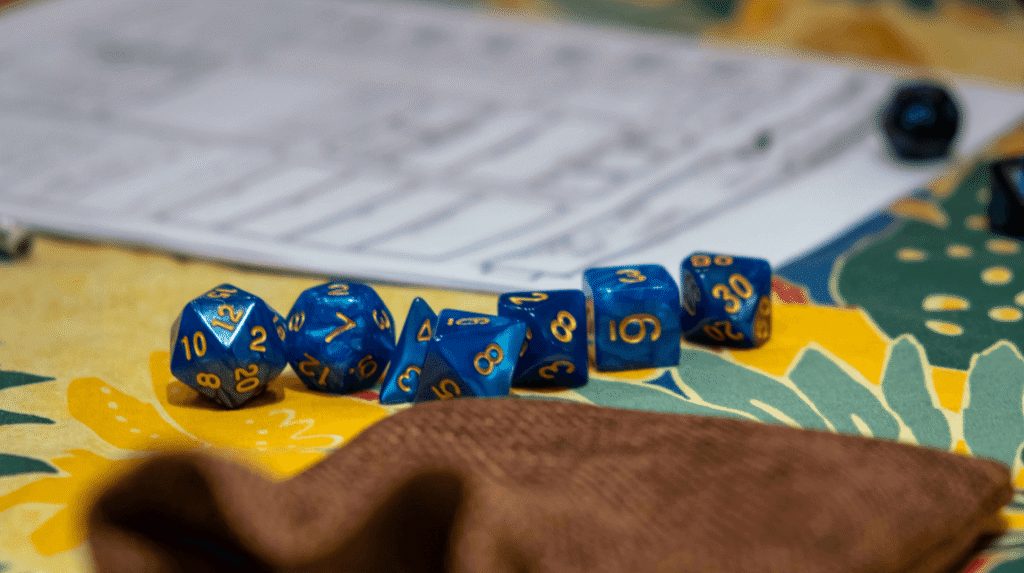
First you’ll need a general outline for your kingdom, region, island, or world. To do this, choose the surface on which you are going to draw your map. Take all the dice you have, using them all in this step, regardless of whether they show different numbers, and roll them onto your canvas. The dice scattered across the canvas will determine the shape of the area you’ll use as a map. Some dice may end up quite far apart. Don’t worry – it’s important to bear in mind that this process is meant to be a source of inspiration. You can move the dice around as much as you like or roll them again until you’re happy with the result.
Rice Map Method
An alternative method for this stage of the process, which is also quite commonly used, is the rice method. Scatter rice onto your canvas in a haphazard manner and let it form the shape of the area. This method is also flexible, and you can alter the shape of your world as often as you like. Once you have achieved the desired shape, take your pencil and trace around the rice, as if you were outlining the coastline. Clusters of rice grains that have ended up outside the main shape can be islands or archipelagos.
2. Assign a different value for each Die
For this step assign a “role” to each of your dice, towns, rivers, mountains, caves, cities, etc. The number of each type of die is also important. This is because it will determine how many of that type of location you find on your map.
For example, if you use the 3 d6 for cities, only three cities will appear each time you roll them. Therefore, you should also bear in mind how many of each type of die you have, in case you need to roll certain dice more than once.
Here you have an example you can use to draw your D&D maps:
- d4: Village
- d6: Lakes
- d8: Rivers
- d10: Forrests
- d10 (percentile): unusual locations, magical locations, creature locations.
- d12: City
- d20: First use only one to establish the capital (in case you are working on a kingdom or region map). Also can be used for other mayor locations like castles, fortress, ruins, or temples.
Mark on the map each location indicated by the dice. You can start with geographical features, such as mountains, rivers, forests and lakes. That way, if any village ends up in a forest or amongst mountains, you can decide whether to move it or leave it where it is.
Combat Encounters and D&D Maps
The major difference between nation and region maps, and combat D&D maps is its use. While the first are used as a prop for the party and the story, the later are used as a tracker for movement, actions and reaction. When creating a D&D map for combat, the layout will show enemy position, tactics and reflect the choices players make during an encounter.
Combat encounters maps are easily identifiable in Dungeons and Dragons. They are usually designed with a grid that helps the Dungeon Master and players to understand movement, distances, positioning and range of attacks and spells. The most common format is a grief made on 2.45cm x 2.54 cm (1 inch squares). In the game each square represents 5 feet of space.
How Cover Works In D&D And How To Use It
Cover represents something, an object or a natural disposition of the terrain between a creature and the attacker. Depending on the coverage it will make the attacher harder to hit their objective.
There are three types of cover in Dungeons and Dragons:
- Half Cover: The object partially covers the creature or party member.
- Three-quarters cover: a Larger obstacle provides significant protection to the party member or creature.
- Total cover: The party member or creature if completely blocked from the attacker
How Elevation Works In D&D And How To Use It
Elevation refers to differences in height across the battlefield. A combat map can include stairs, balconies, cliffs, rooftops, hills, bridges, etc. Elevation gives players and creatures tactical perspective and, in some cases, advantage.
When drawing elevation in your map, make sure the different heights are easy to understand visually. Whether you are using objects or colours and labels to show which areas are higher or lower.
Map The World Of Your Campaign And Bring Your Adventure To Life
Creating D&D Maps is part of the creative process and world building. Maps can serve as a prop for the party and a way for the Dungeon Master to tell the story. In order to create maps that your players will feel the need to interact with and take into account during their adventures, use their backstories and relationships for inspiration. A mysterious location could hold the answer to a question the character has been carrying since the beginning of the campaign.
This is where D&D Maps become storytelling tools. Don’t be afraid to let the map evolve alongside the campaign, add locations, secrets, characters and creatures. The more you connect the map to the players and their characters, the more personal and meaningful the world becomes.
Join us and find fellow Dungeon Masters to share ideas, exchange inspiration, and build unforgettable adventures together.
Game on!
- Invokyr A Video Game about a Forgotten Board Game
- Dressmaker, The Fashion Game that’s Conquering the Internet
- One Piece Escape from Egghead, A Strawhat Adventure
- The Sift, The New Dimension in Minecraft Dungeons II
- Microsoft Files a patent to insert Ads while you play

- Thomas Spitze’s Coal Trilogy For History Enthusiasts