
Party games bring something special to family gatherings, game nights and celebrations. With simple rules, inclusive play for those unfamiliar with complex board games, and adaptability to house-made rules are what make party games so special.
These games do not rely on deep strategies, complex rules or detailed campaigns, but make truly unforgettable experiences for the players where fun is not only the objective 一 it’s the entire journey.
What defines a party game
We’ve talked a lot about complex, long board games with incredible structures that transport players to fantasy, futurístic and extraordinary worlds. Now it’s time to talk about another type of board game which, although simpler in structure and rules, fulfills the greatest purpose of play: bringing people together.
Party games are designed so anyone can jump in within minutes, regardless of age and game experience.This easy requirements and conditions create an immediate sense of comfort and inclusion around the table.
Key Features of Party Games
Party games come in a wide variety of shapes and forms. Contrary to popular belief, not all party games are based on card games, and not all require a board. Some of them use unique physical elements that are different from what board gamers are used to. Some rely on verbal interaction, conversational, creativity and imagination.
At the same time, all party games share the same key features that make them truly unforgettable experiences.
Simplicity
Designed to learn in minutes, with simple rules and game mechanics. Easy to explain and quick to remember. This context removes the learning barrier and helps the players jump straight into the first round. Without the need of long tutorials or a complicated board game set up.
Adaptability
One of its most remarkable features. Party games can be adapted to almost any group or environment. Players often vary rules or modify the gameplay to adapt the play to their house-made rules. This approach keeps the experience fresh in every play and allows each group to make their game their own.
Inclusivity
Party games combat isolation. These board games do not require prior gaming experience, deep strategy or special skills. Whether it’s during a family event, with friends or as an icebreaker with new acquaintances, party games create a welcoming space for anyone who wants to join in.
Replayability
The replayability of party games come from their ability to bring people together and the experiences and fun they provide. Each game sparks new interaction, unexpected moments, inside jokes and laughter. Party games rely on their replayability through the effect they have on the players 一 fun that is driven by social connection rather than complex strategy.
Party Games for Every Game Night
Cards Against Humanity
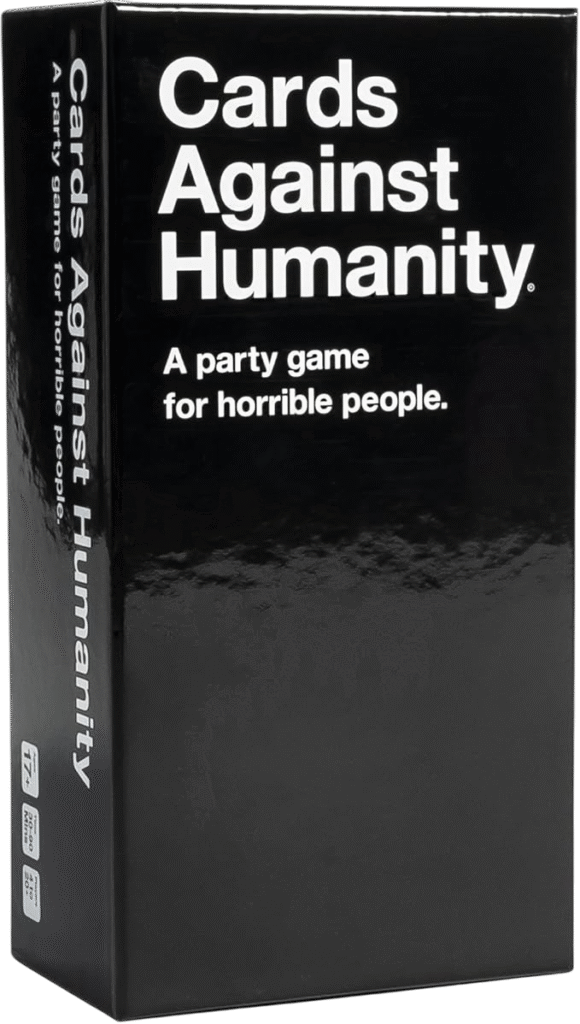
👥 Players: 4-30
🕑 Duration: 30 min
⚔️ Competitive
One of the most famous party card games worldwide in which players complete fill-in-the-blank statements using humorous or offensive phrases printed on white cards. The goal of this game is to create the funniest or most shocking combinations judged by the rotating player called the “Card Czar”. This party game is great for bringing non-gamers to the table and exploring what makes other players laugh.
Its simplicity and creativity based mechanics makes Cards Against Humanity, one of the most played party games in the world.
Game Setup
- Each player draws 10 White Cards.
- The players must decide who will be the first “Card Czar” or judge of the round.
- The “Card Czar” draws a black card and reads it outloud. These contain a sentence with a blank or a question.
- Each player submits one white card from their hand face down to de Card Czar.
- The Card Czar shuffle the submitted white cards, reads them aloud and chooses the funniest or most fitting.
- The player whose card is chosen wins the round and keeps the black card as a point.
- Next round: The role of Card Czar rotates clockwise. Players must draw back up to 10 white cards and the new Card Czar takes another black card.
💡Make it more exciting
To make it even more engaging and competitive, try modifying the role of the Card Czar: the player who wins a round becomes the card Czar in the next round. You can also add a clear objective, for example, the first player to win ten rounds is the overall winner.
Happy Salmon
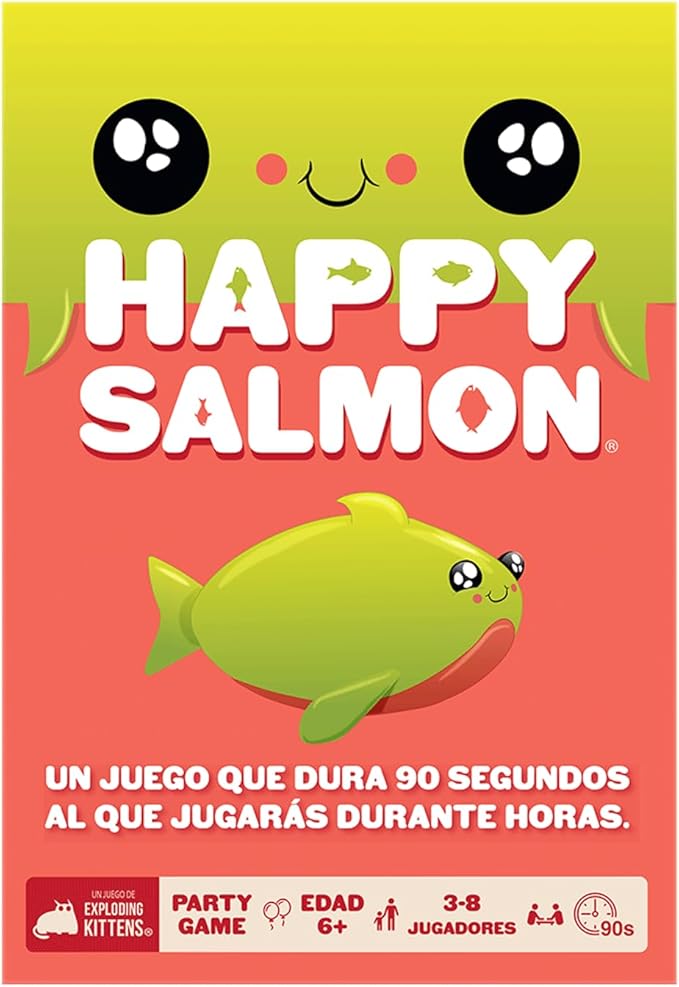
👥 Players: 3-6
🕑 Duration: 20 min.
⚔️ Competitive
Happy Salmon is a Fast- paced party game in which players race each other to match action cards. The goal of the game is to be the first player to empty your deck of cards by completing each objective, creating a burst of chaotic fun, perfect for all ages.
How to play
- The game is divided into different decks of cards, by colour.
- Shuffle the cards and position them face-down.
- Draw a card and find another player with the came cards as you to complete the objective.
- Type of cards:
- High five: Players need to find someone with the same card and give each other a high five.
- Pound it: Players match with someone else and do a fist bump.
- Switcheroo: Players need to find someone with the same card and switch places.
- Happy Salmon: Players perform the signature flappy-arms handshake.
Happy Salmon is a great example of simple rules that can deliver a lot of fun. Accessible to everyone, regardless of age or experience playing board games. Perfect for family gatherings where the age range can vary widely.
Jenga
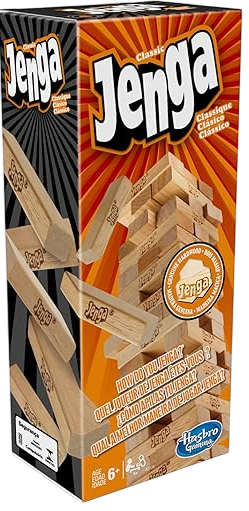
👥 Players: 1-8
🕑 Duration: 20 min
⚔️ Competitive
No cards and lots of physical dexterity. Jenga is one of the most famous party games worldwide in which players take turns removing wooden blocks from a tower and placing them on top. The tower becomes increasingly unstable with each move. The objective is clear: do not let the tower fall during your turn.
Allowed actions during the game
- Remove: Players remove carefully and slide out a single block from anywhere below the highest completed level of the tower.
- Stack: Players placed the removed block on top of the tower, creating a new higher level.
- Stabilize: Players can 一gently一 touch the tower with one hand at a time to check for those loose blocks or steady it while removing a block.
💡Make it extreme
If you are looking to add an extra layer of challenge to the game, try making it extreme by staking blocks vertically or placing them only partially on top. This small twist dramatically increases the tower’s instability.
Unstable Unicorns
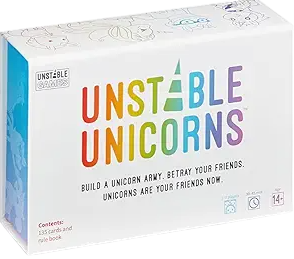
👥 Players: 2-8
🕑 Duration: 45 min.
⚔️ Competitive
A strategic, competitive card game where players aim to build a stable of uniforms while sabotaging their opponents. Each player uses a combination of unicorn cards, upgrade cards and downgrade cards. The objective is to be the first player to assemble a certain number of unicorns in your stable.
Turn Structure
Each turn will consist of three phases:
- Draw Phase: Draw one card from the deck to start the turn.
- Action phase:
- Play a unicorn card to add a unicorn to your stable.
- Play upgrade cards to boost your stable.
- Play downgrade cards to disrupt other players.
- Play magic cards to trigger special effects.
- End Phase: some cards will allow extra actions during this phase.
❗Unstable unicorns might be a more complex option for a party game. But the simple rules make it easy to learn and remember.
UNO
👥 Players: 2-10
🕑 Duration: 30 min.
⚔️ Competitive
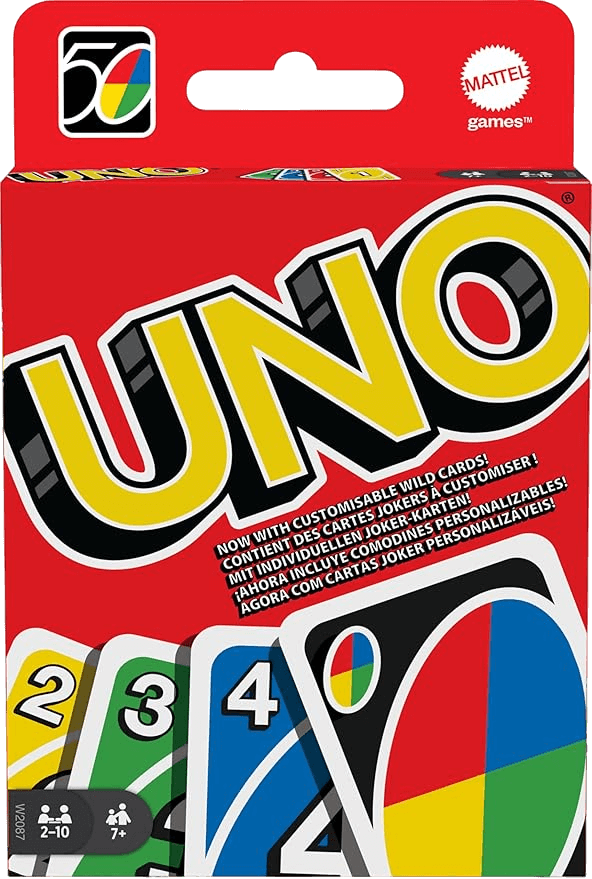
The king of party games. UNO is the most famous competitive card game. Accessible to all ages and easy to learn for beginners. A fast-paced card game during which players race to be the first to get rid of all their cards. Players match cards by number or colour and play special cards like skip, reverse, +2 or +4.
Turn structure
- Players match a card from their hand to the top card of the discard pile by either colour or number.
- Drawing a card if the player cannot play any card on their hand.
- Play a special card if it matches the colour of the top card of the discard pile.
- Players must call UNO if they have only one card left. If they fail to do so, they must draw six extra cards.
👑The king of house-made rules
There are as many versions of UNO house-rules as there are towns on Earth. The most popular include stacking of +2 and +4 combined, allowing players to pile penalties on top of each other. Also the house-made rule where players draw cards until they find one that matches the top card of the discard pile.
Party Games are Sometimes the Forgotten Ones
When talking about board games, party games are often overlooked. Their lack of complexity, detailed boards and miniatures or tokens can make them seem less elaborated or serious in comparison. However, it is this same simplicity, and strong reliance on social connection what makes them replayable and accessible.
Why Some Gamers are Divided on Party Games
Some experienced gamers prefer deep strategy, intricate mechanics and long campaigns that challenge their skills in planning and decision-making. To these players, party games can seem too simplistic or chaotic. The fast-paced and often unpredictable nature of party games can feel shallow compared to the immersive experiences of heavier,deeper board games.
However, these same qualities that divide opinions are also what make party games special. Party games dominate their own space and moment, winning over new players. They turn simple social gathering into an incredible fun experience. Recognising their role ensures that no board game is overlooked.
All Board Games Matter, Party Games Included
Board games come in many shapes and themes. from epic adventures and deep strategy-based games, to quick laughter-filled party games. While complex and long games challenge the mind and immerse players with complex roles, party games excel at fostering connection and shared joy.
Every game has value, and what’s most valuable about party games is the power to bring diverse people together. Gather your crew! Party games are perfect as an icebreaker. Connect with other players and make every game night unforgettable.
Game on!