
When No Man’s Sky won the Best Ongoing Game of the Year in 2025, the community backed it up, acknowledging what has become one of the largest redemption stories in video game history. From its launch failure ten years ago in 2016 to becoming an incredible galactic exploration game with multiple possibilities.
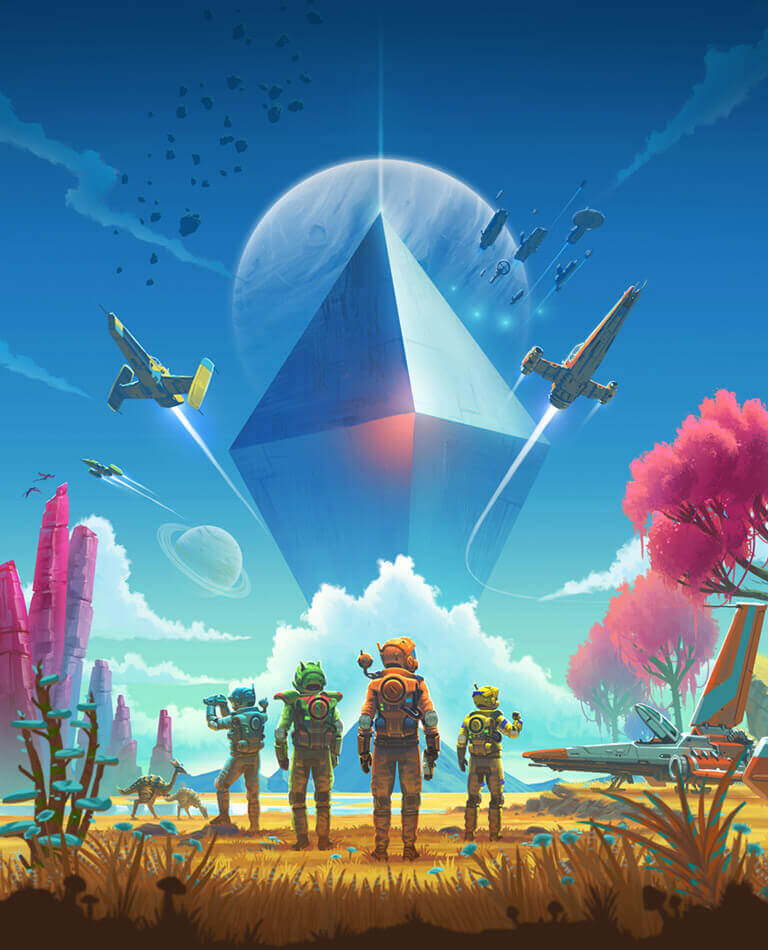
The Evolution of a Whole Galaxy
A Complicated First Launch
No Man’s Sky was first released in August 2016 as an action-adventure survival game, developed and published by Hello Games. The game was built around four essential pillars: exploration, survival, combat, and trading. However, its reception was one of the most controversial in modern gaming history.
After years of massive hype, filled with trailers and interviews promising a vast, open generated universe, full of exploration and opportunities, the video game did not reach the users’ expectations and the initial excitement quickly gave way to disappointment, once the players experienced the release version.
❗During its first release in August 2016, on steam alone it drew over 210,000 players.
Players found that several features widely expected by the community weren’t really in the game. Features like the multiplayer mode, highly expected by gamers, simply weren’t present at launch. Many players felt that the core experience and plot was shallower and less interactive than advertised.
The response, on Steam alone, was overwhelmingly negative, with roughly 12% of the reviews on the platform in the first 30 days were positive. This backlash put No Man’s Sky on the podium of being one of the lowest rated games on Steam. For many users, No Man’s Sky was not the game they were expecting.
Ten years have passed since the game’s first launch. What has changed? How has the game improved?
Best Ongoing Game, What Changed?
What changed is that, after the negative backlash, Hello Games treated the launch as a starting point instead of a finished product. The studio and publisher went quiet publicly but kept working on the video game, releasing large, free updates that complemented and expanded the game experience.
Abandoning the project was never an option.
2016-2017 Foundation Update and Pathfinder
The Foundation Update, released in November 2016, was the sign that the studio wasn’t abandoning the game.
- This update introduced base building, letting players claim a planet as a home and build their own base with permanent structures. This alone changed how gamers saw No Man’s Sky, from a “fly to the next planet” game to a sandbox where players could settle and progress.
- New farming systems were added, allowing players to grow resources instead of relying entirely on random discovery.
- New Game Modes were also introduced:
- Survival: With harsher conditions and higher risks. Storms and planetary hazards drain life support more quickly. Resources are scarcer and inventory limits are tighter.
- Creative: Removed most constraints. Players have unlimited resources, no crafting costs, no survival hazards and instant access to building parts and technology.
In 2017, Hello Games introduced Pathfinder. Focused on exploration and improvements. The planet variety was enhanced, introducing new biomes and visuals, it also introduced exocrafts (land vehicles), allowing players to travel planets faster and making exploration less repetitive.
It also introduced the Atlas Rises narrative and structure, a full story campaign with lots of lore, mission systems and early multiplayer features. While limited, this was the first step towards real multiplayer experience.
2018 True Multiplayer Update
The Update everyone was waiting for and the biggest shift in perception. The true multiplayer update added a third-person camera, major graphic updates, and a full rework of progression systems.
The video game finally matched its original vision for 2016. Gamers started going back to the game and reviews began improving significantly.
2019-2020 Beyond and Origins
These were the updates that marked a shift from recovery to expansion of the video game.
In 2019, the Beyond update added full VR support and a greatly expanded multiplayer hub named The Space Anomaly.
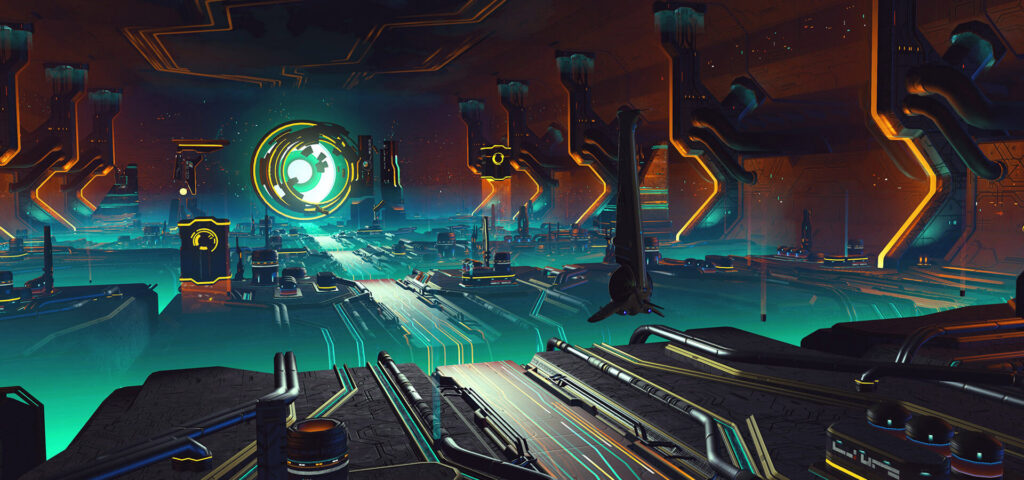
A shared, instance space station where multiple players could gather in real time, the Space Anomaly shaped No Man’s Sky structure and community. This space houses NPc’s as well as provides progression to the story; upgrades, blueprints, research paths and multiplayer missions.
In 2020, the Origins update improved vastly planetary variety, adding more biomes, terrain types, weather factors and anomalies, as well as new flora and fauna. These changes and new features made exploration feel meaningful for the gamer and less repetitive. At the time of this update, the video game had completely changed from its first release in 2016.
2021-2022 Community Events
The introduction of the Expeditions update gave players time-limited events with structured objectives, shared milestones, and exclusive rewards.
Instead of starting alone in a random system, players begin an expedition in the same region of space as everyone else. Each expedition has its own objective such as exploring planets, upgrading technology, or building. Completing these unlocks exclusive rewards like ships, cosmetics, titles, and companions.
This update also added Settlements, letting players oversee and develop NPC towns, combat improvement and the possibility of having pets. These changes reinforced the idea that No Man’s Sky was not a static sandbox, but a living universe with ongoing expansion and development.
2023 Improved Mechanics and Visual Fidelity
From 2023 to present day, No Man’s Sky has focused on refinement and expansion, improve visual fidelity, lightning, and planetary detail.
- Space combat and freighter gameplay were expanded with deeper mechanics, customization and fleet management.
- Automation systems, inventory improvements and reduced friction have made long play sessions smoother and more rewarding.
No man’s sky is no longer the video game released in 2016. The game has far more content than was ever promised before its original launch. Reviews have eventually reached the “very positive” rating, and the video game is now commonly cited as one of the largest redemption stories in gaming history.
For those who know nothing about the game: What is No Man’s Sky?
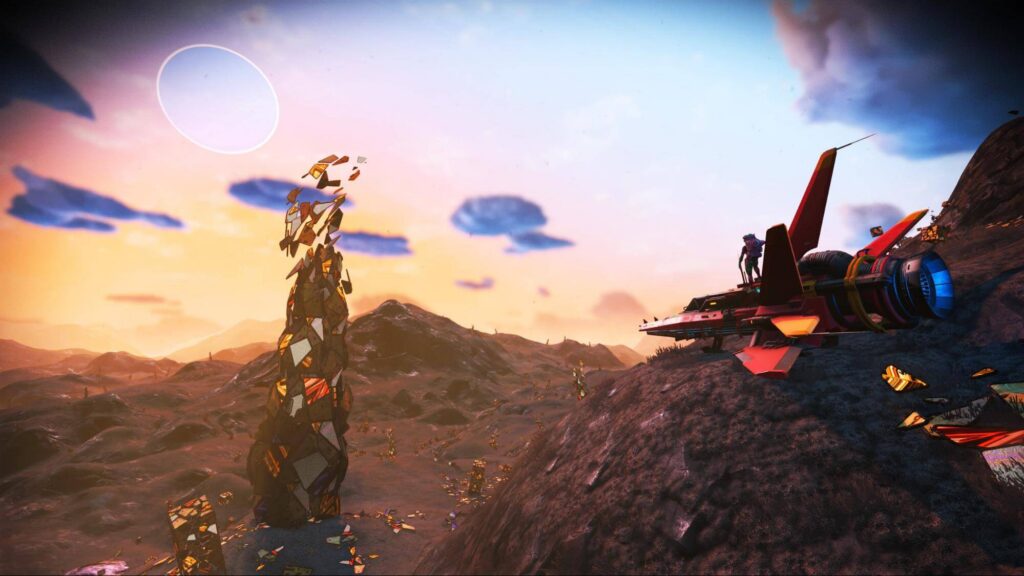
Uncover the mysteries of Artemis and the fourth race
The narrative part of No Man’s Sky revolves around The Atlas, an omnipresent cosmic entity that is the alleged creator of everything that exists in the universe, and the object of worship of the cybernetic Korvax and the reptilian Gek.
The players follow clues left by Artemis, a humanoid explorer who reaches out to the player. As they explore, they encounter the so-called fourth race, a previously unknown species, enigmatic and largely absent, leaving only traces of its technology and influence scattered across the planets.
Through clues, messages, the uncovering of abandoned structures, and finding anomalies, the player uncovers the fate of Artemis and the fourth race. The plot of the video game emphasizes themes of connection, isolation and the search of meaning in an infinite universe.
Ultimately, the players reach the atlas interface and must decide whether to continue Artemis’ journey or break the circle.
An Open Universe to Travel and Explore
No Man’s Sky is the perfect game for exploring, a truly open universe with near-infinite possibilities. An interactive experience in which players can mine resources, catalogue alien species, build bases, trade with factions, and uncover hidden lore.
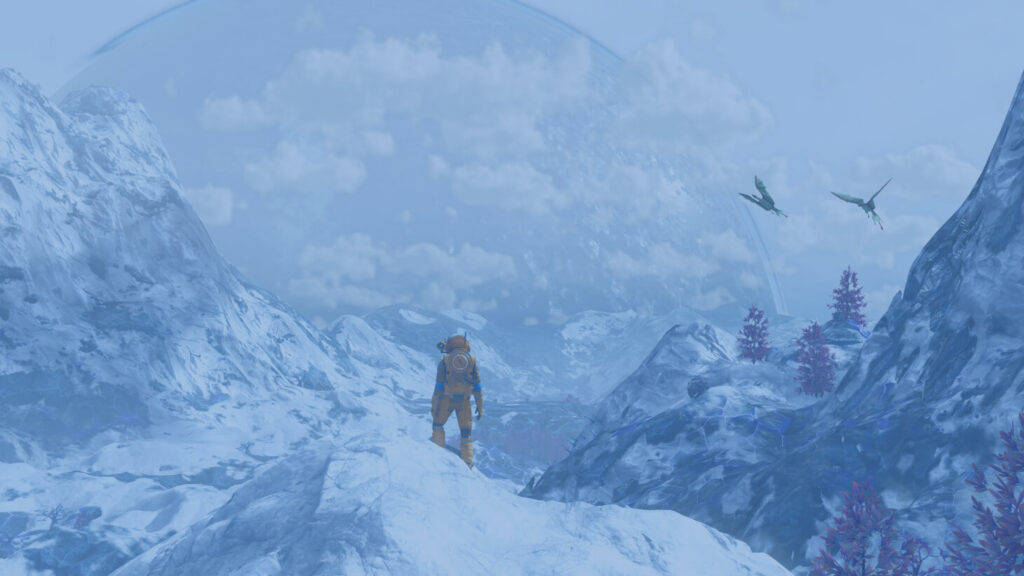
This also categorises the game as a comfortable/cozy game, for those players that are not really interested in following the plot, but appreciate an open universe and the building possibilities. The developers know this and that is why the game also rewards curiosity, such as decoding alien languages or locating hidden structures.
Whether you want to wander alone through a peaceful world, participate in community events, or engage in space combat missions, the open-world design offers you complete freedom to choose your path.
Gamer Tips for No Man’s Sky
If we have convinced you to try No Man’s Sky, here are some tips to take into account that will make your experience even more enjoyable:
- First resources to stack up:
- Carbon: Gather it from different forms of flora. Carbon fuels the multitool and life support systems. Keep always a significant stack of carbon so you can recharge.
- Oxygen: Harvest if from some plants and atmospheric deposits. Essential for life support.
- Ferrite dust: Found in rocks and almost everywhere. Essential for building, crafting and base components.
- Di-Hidrogen: Found in blue crystals, this element fuels your launch thrusters.
- Easy ways to make units (money):
- Sell cartographic data: Scans from fauna, flora, minerals and star systems. You can sell these at a space station or trading post.
- Valuable minerals: Gold, Platinum, Emeril, Chlorine, Cadmium or Copper.
- Collect and sell salvage: Salvaged data, circuit boards and technology modules you’ll find on wrecked ships, abandoned buildings and debris.
- Upgrade your multitool and ship early in the game. Better mining lasers and hyperdrive upgrades make resource gathering and exploration faster.
- Identify and prioritise economic systems. Trading posts and space stations on high-economy planets give better prices for selling discoveries and resources.
A New Universe of Adventure Awaits
From your very first steps on an alien planet to commanding freighters, building bases, or uncovering hidden lore, No Man’s Sky always has something new to explore. If you are looking for a new galaxy to explore and discover, step into No Man’s Sky, whether survival, creative or multiplayer cooperation.
Find gamers and embark on this new expedition. Fuel up your starship, gather resources and chart a course into the unknown, a whole galaxy of adventure is waiting for you.
Game on! 🚀🧑🚀