
Horror board games bring the thrill of fear into the play sessions. The immersion of the players into suspense and the unknown make these horror games so unique.
Whether you are escaping a monster or facing an unknown traitor, horror games use fear and suspense as a tool to enhance tension and strategy. However, we’re going to talk about horror board games that take it a step further. These board games don’t flirt with fear, they fully immerse you in it.
⚠️ Content Warning!
Attention players! Some of the horror board games discussed in this article feature mechanics or themes that simulate sensory deprivation, claustrophobia or/and psychological stress. These games are designed to evoke fear, disorientation and tension, and if at any point you feel you can’t play or continue, that’s completely fine. Not every game is for everyone.
What makes a good horror board game?
A horror board game creates a genuine emotional response in players. Whether it is a competitive or cooperative board game.These horror board games use mechanics, themes and atmosphere to get the suspense and paranoia in the game.
The best horror games have some factors in common that make the board game truly immersive and leaves the players with the desire to play it again.
Tension-driven mechanics
In horror games, tension leaves its categorisation as a consequence and plays directly as a mechanic in the game. These are carefully designed to create uncertainty and vulnerability. Decision making can lead the play session into a potential disaster. Players can lose their progress or even die. This system keeps players guessing and emotionally invested in the game, from start to finish.
Some of this tension- driven mechanics are:
- Limit player control
- Forcing difficult decisions under pressure
- Difficulty escalation
- Punishment of hesitation and/or mistakes
These mechanics can change or adapt depending on whether the horror board game is competitive or cooperative.
In cooperative horror board games the players’ main enemy is the game. Players share objectives, fear and failure. The pressure over decision making is collective. Players must work together under the stress and often limited communication or time.
However, in competitive horror boardgames tension and fear are personal. Players must watch their backs for other players who might turn on them. Mistrust, hidden objectives and betrayal become key tools to unsettle players.
Player vulnerability
Unlike adventure and fantasy games, in which players grow stronger and receive power-ups or resources, horror board games play with vulnerability’s emotional hook. Horror board games make the player tense, stripping them away from resources, control, safety and even agency.
Player vulnerability is achieved by several factors that can alter the game. These factors make fear real for the players. When a horror board game forces its players to a cornered situation it mirrors the emotional core of horror.
Some of the factors are:
- Hidden information or events.
- Moral dilemmas
- Limited resources
- Low control of the game events
- Permanent consequences
In competitive or asymmetric horror board games, the players (or player) might sense a not-so-real confidence in their actions. This situation can change throughout the game. Early successor temporary control can create the illusion of safety and advantage.
While in cooperative games, where all players go against the game itself, vulnerability is often an immediate feeling. Players rely on teamwork and action coordination, but with constant pressure and limited resources, failure always feels a turn away.
Narrative and emotional stakes
Narrative is everything in horror games. The story of survival, sacrifice and dread forces the player to make choices that have emotional and personal consequences in the game.
Narrative is the motivation for players to survive. The story and its consequences, tied to the players’ decisions and actions, make horror board games a unique experience and raises its replayability.
In horror board games, these include
- The possibility of death of a character
- Unfolding the back story and new clues
- The psychological toll of survival
- The cooperation or integrity of the players’ group
In competitive horror board games, narrative elements may affect each player differently. These games often introduce asymmetric objectives, secret agendas or individual backstories. These narratives also unfold in conflicting ways, with players reacting to each event based on their own objectives.
In cooperative board games, narrative often shares an emotional thread that ties and pulls players to a common emotional response. The story unfolds collectively and each player’s actions affect the common strategy. These cooperative horror games tend to emphasize solidarity, moral dilemmas and collective loss.
Horror games that take it a step further
On the other hand, some horror games don’t settle for eerie settings or spooky stories, some of them aim to truly overwhelm the players.
These games can make the players feel isolated and helpless, built to immerse and sometimes shock them. These horror board games take it a step further with mechanics that directly affect the player. Such as:
Sensory deprivation
Blindness 🕶️
Some horror board games incorporate blindness of the player as a core mechanic. By limiting one of the players’ senses, they amplify the immersion and disorientation.
This mechanic can be achieved completely by blackout glasses, or blindfolds. In these cases, the board itself tends to have tactile elements for the players to orient their tokens.
There is also the mechanic of partial-blindness. And this can be achieved if the character in the game has a lantern or a flashlight, so the game will only show the player what the character can see.
Silent play or forbidden Communication 🔇
One of the most common and most intense ways horror board games build tension. By taking something players often take for granted, the ability to communicate,and cutting off player communication creates a feeling of being stranded.
This resource can appear as a completely forbidden communication during the game or a limit to what the players can say or who can hear them.
Tactile-only interaction 🫳
While in most games, players rely on communication and sight, some horror board games limit the interaction of the players to tactile-only. This mechanic is rare, but equally powerful, transforms the game from a strategic experience into a physical and psychological one. By using tactile-only interaction with the game, players are pushed to an unfamiliar way of playing.
Themes of isolation or helplessness
Emotional Isolation 👤
Isolation and helplessness as a consequence, are foundational themes of horror. These games don’t just try to scare the players with monsters or villains. These games aim to make them feel alone and even emotionally detached from the other players in the group.
Loss of control ‼️
Players are not in charge of their fate, not even of the mechanics of the game, once they learn them.Fear deepens when the group realises that their decisions might not matter or that there is something or someone else pulling the strings of the game.
Existential Helplessness 😨
In these types of board games, helplessness is the unsettling feeling that your actions as a player might not have any effect. Irreversible losses or unknown threats to which the players can not prevent or survive.
Dear player, now that you are prepared, It’s time to step into the dark. If you are ready to test your nerves and face the unknown, proceed carefully. Not all horror board games are meant to be escaped.
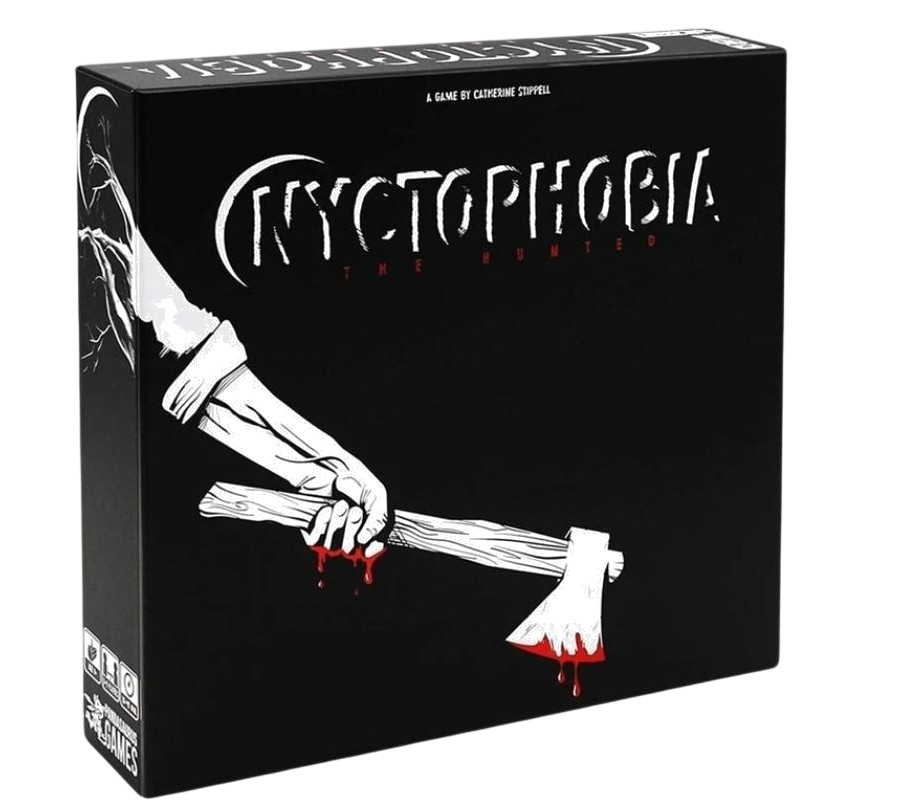
Nyctophobia
Blindness 🕶️
Tactile board 🫳
Players: 3 – 5
Nyctophobia was published as an experimental horror board game. An asymmetrical board game where most players must wear blackout glasses and must navigate a forest entirely by touch.
The story
A group of survivors (the players) are lost in the dark, deep in a forest hunted by a relentless killer (one of the players) lurking in the shadows. The survivors have to navigate the forest, avoid deadly traps and find the car to escape the hunter.
This horror game is less detailed about the narrative and focuses on evoking fear and discomfort using sensory deprivation.
Game mechanics
- Its core mechanic is sensory deprivation, sight to be exact. The game creates paranoia and reliance. Survivors depend both on touch and player communication.
- One player takes the role of the hunter, this will be the only player without blackout glasses.
- Survivors must stay calm, cooperate and avoid the killer while escaping.
⚠️Caution players!
Nyctophobia is a horror board game with a psychological experiment within the game. We recommend discussing boundaries before playing and ensuring everyone is comfortable with the experience.
The night cage
Partial – blindness 🕶️
Emotional Isolation 👤
Players: 1 – 5
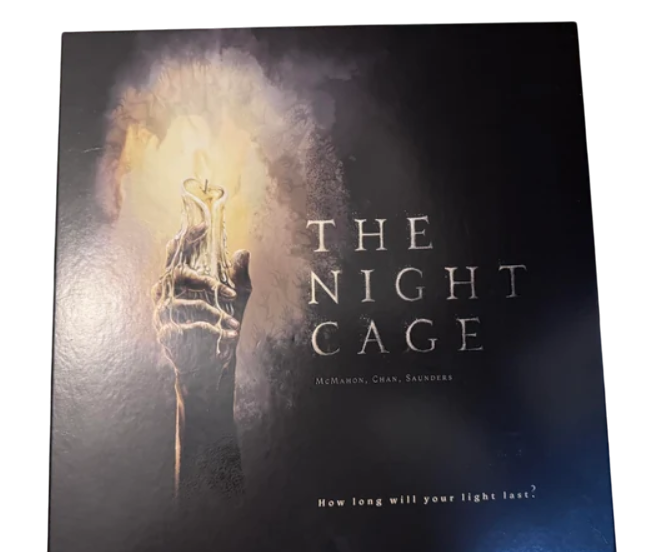
The night cage is a cooperative horror-maze board game. This game plays with the limited vision of the players and the disappearing map to trigger the player’s fear and emotional isolation. The players must work together to find the keys and escape the labyrinth.
The story
The party are prisoners, trapped in a pitch-black labyrinth with no memory of how they got there or why. Each of them carries a candle that casts a dim light around them. Whenever they move, the space not illuminated by the candle disappears into the void.
They are lost in a shifting nightmare that reconfigures constantly.
Game mechanics
- Its core mechanic is tile placement. Players draw tiles to build the labyrinth ahead of them.
- During their turn, players have the option to move one spare orthogonally or stay in their position.
- The game uses a hidden-event mechanic to introduce monsters and challenges to the players.
⚠️Warning!
The night cage is an emotional experience. Forcing them to isolation and offering what it seems like a never ending maze ahead of them. In this game, patience is survival, silence is wisdom. The maze does not want the players to escape.
Ten candles
Partial – blindness 🕶️
Existential Helplessness 😨
Loss of control ‼️
Players: 3 – 6
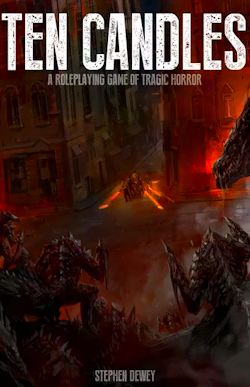
Ten candles is a narrative RPG and boardgame. The players take the place of a group of survivors trapped in darkness. Played with real candles, the players have to narrate their last hours.
The story
Ten candles narrates the story of the few survivors in the midst of a sunless apocalypse. Players take the roles of these survivors living the last few hours of their character lives. The game master controls the unseen adversaries who stalk the players and wait just beyond the light’s edge. Ten candles tells the story of what happens in the dark. What happens to those who fight it and their inevitable end.
Game mechanics
- The game is played with ten real candles.
- Players take turns narrating what they do, feel and reliving flashback scenes that reveal their backstory.
- The game is not a play-to-win. When the last candle goes out, the story concludes with the deaths of all characters.
⚠️Attention players!
This game must be played in a safe space. The ten candles used for the game are real please be mindful of fire safety at all times. Moreover, this game deals with a sensitive topic (death). Feel free to tap out of the game, warn the game master and the group when you feel uncomfortable.
Don’t look back
Existential Helplessness 😨
Loss of control ‼️
Players: 1 – 6
Don’t look back takes classical horror cinematics and transforms them into a horror board game. It is a solo or cooperative tabletop miniatures game that delivers a horror experience full of suspense and terror.
The story
Players control four heroes battling against a randomly generated killer across a 3×3 foot playing surface. The players find themselves in one of the five scenarios the game provides (ex. Dead Man’s Hollow). Someone is watching them, hunting them. The killer emerges from the shadows driven by rage, vengeance or something even darker.
Game mechanics
- Don’t look back is an experimental horror game because, rather than using abstract mechanics, it mimics the pacing and structure of a classic slasher horror film.
- Players have 2 actions per turn: Move, search, use an item, interact or attack.
- The objectives are clare, escape,rescue,survive and, above all, don’t look back.
⚠️A word of advice
From this ranking, this might be the softest horror game we speak of. However, please remember the most important rule in board games. Comunícate. If you feel isolated or triggered by the game, let the other players know.
Do you dare to play these horror board games?
There are all sorts of horror board games. Some are adventure-driven, survival, these are experimental and try to push the players to their emotional limits.
If you trust your group of players and you’re looking for a different kind of plan this Halloween, dive into fear together with an immersive horror board game.
If you want to try any of the games explained above, but your game group is not ready for it, find other players in gamers.online.
Are you scared yet?