
This past January, the District Court of Rotterdam upheld the decision by the Authority for Consumers and Markets to fine Epic Games, the parent company of the popular video game Fortnite. The €1.1 million fine is based on the finding that the company had engaged in unfair commercial practices, relating to the in-game shop scarcity practices and timed purchases.

Legal Basis for the Fine: Incitement of Minors to Make Purchases
In May 2019, ACM became aware of a study conducted by the Institute for Information Law of the University of Amsterdam, concerning the impact of Fortnite on children’s judgment in relation to transactional decision-making. Getting under your skin(s): A legal-ethical exploration of Fortnite’s transformation into a content delivery platform and its manipulative potential.
This study states that accordion to the very definition of the word “manipulation”一an influence that may be regarded as hidden where the existence of underlying strategy is concealed from the individual concerned. Fortnite has designed a digital choice of architecture that exerts influence over players. This statement is divided in two main characteristics or strategies of the game:
Staying on the hook
Fortnite employs a system of rewards combining fixed, timed, random and variable rewards. Fixed and timed rewards provide gamers with predictable incentives that encourage continued play. Random rewards introduce uncertainty and excitement, and variables give the users a sense of control and achievement.
Fortnite’s engaging appeal and replayability to gamers is rooted on its clever game design, its strong pop-culture presence, and social functions the game has.
In-game Shop
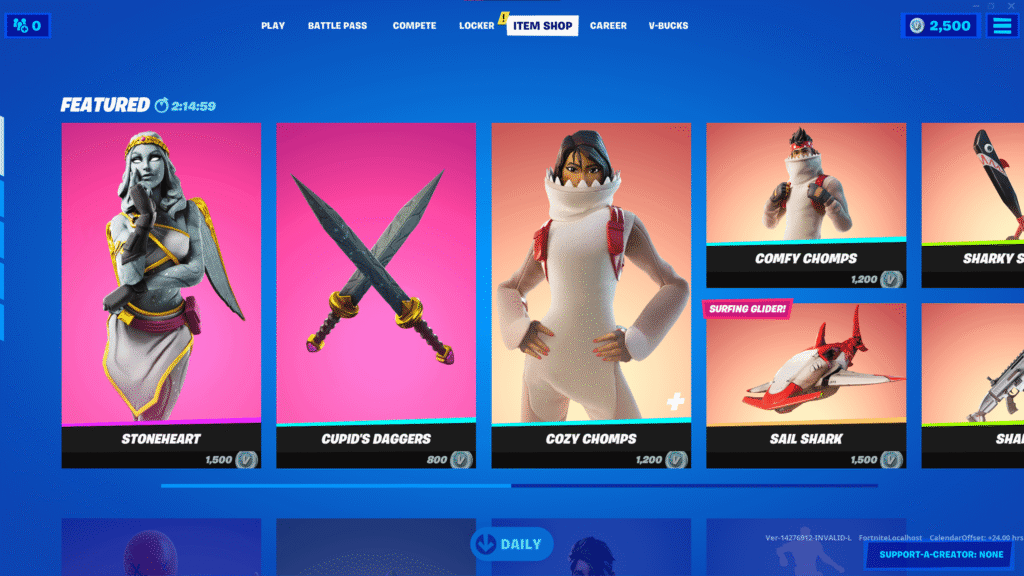
Epic Games’s former head of UX research, Celia Hodent said that in-game purchasing is deliberately designed to feel “cute” and enjoyable, aligning with the game’s overall aesthetic. These purchases are made using V-Bucks, an in-game currency that reduces spending inhibitions and obscures the real-world value of these items.
This overall design creates a feeling of missing out, as rewards and featured items may disappear without warning or an indication of returning to the catalogue. It encourages players to revisit the game frequently to monitor daily changes.
On that basis, ACM initiated an investigation into Epic’s commercial practices. The results of the investigation were a draft report. This concluded that Epic had engaged in several misleading and aggressive commercial practices within Fortnite. Epic Games was then given the opportunity to respond and submitted its views on the investigation report, along with financial information and an expert opinion.
ACM later informed Epic Games of its intention to amend the legal qualification of one of the infringements identified in the report. A draft elaboration of the revised infringement and a draft binding instruction were provided to Epic. Epic subsequently submitted additional comments, which the authority took into account for their final assessment.
On the 14th of January, 2026 the District Court of Rotterdam (Netherlands), published the judgement ruling that the Netherlands Authority for Consumers and Markets was correct to impose fines and a biding instruction on Epic International sames S.à.r.l, the developer of Fortnite. The court thus dismissed the appeal by the American company.
The Vulnerable Average Consumer
According to Statista more than 60% of fortnite players are between 18 and 24. Underage users have stricter default settings, including disabled voice chat. Players under 13 receive “cabined accounts” which restrict voice chat, text chat and purchasing items. However, this does not mean that they are banned from the in-game shop or from making in-game purchases. For a Cabined Account, purchases with real money are disabled until a parent or guardian provides consent. A parent or guardian must provide an email and complete the consent process for the child to access features that include buying items.
Children are more vulnerable to commercial practices than the average consumer. ACM, together with the study conducted by the University of Amsterdam determined after investigation. Fortnite exposes this audience to design features that exploit this vulnerability. By using timers and rotating offers, children are likely to believe that items become unavailable once a timer expires, influencing their purchasing decisions.
The more pronounced scarcity, the stronger the FOMO (fear of missing out) effect and the bigger risk of impulsive purchasing. This scarcity also comes with an illusion of additional positive value towards the products on display, as a means of differentiation from others.
This, comes into conflict with the European guidelines on measures to ensure privacy, safety and security for minors online:
“(i) Ensure that children are not exposed to techniques which can have the effect of reducing transparency of economic transactions and may be misleading for minors, such as certain virtual currencies (79), and other tokens or coins, that can be exchanged with real money (or, where applicable, for the purchase of another virtual currency) and used to purchase virtual items, thus also cause unwanted spending (80).“
- Guidelines on measures to ensure a high level of privacy, safety and security for minors online, pursuant to Article 28(4) of Regulation (EU) 2022/2065 (C/2025/5519)
Epic Game’s Grounds of Objection
Epic does not agree with the violations established by ACM, nor with the fines and binding instruction imposed in respect of them. It is important to note that Epic has built parental controls into the Fortnite game. These controls concern playing time and chat functions. However, as previously mentioned these do not fully apply on the making of purchases.
Epic argues that the studies are merely correlational and do not establish causality. ACM accepts that the studies are correlational in nature, but notes that these facts are grounded in established theory and existing literature, from which hypotheses are created. The Video Game company contests that the Fortnite Shop employs scarcity or exploits children’s vulnerability. It argues that ACM breached principles of due reasoning and care. As the scientific literature cited does not demonstrate that scarcity claims increase children’s impulse purchasing, or exploit their desire for differentiation through in-game items. They further maintain that purchasing decisions are driven mainly by aesthetic preferences.
Epic also objected that it is likely that players of Fortnite know that there is no real scarcity in the Third Party items sets on offer. So these items cannot be classified as conspicuous consumption. Also, Epic correctly notes that there is no relationship between age and the number of V-bucks purchased.
The Court’s Assessment and Ruling
The ACM has imposed a fine and a binding instruction on Epic Games for unfair commercial practices in the Battle Royale mode of Fortnite. The court agreed with the ACM that the advertising messages in the game directly encourage children to make purchases. This, concerning strategies like wording items with “get it now” or “grab it” call to actions.
ACM also correctly found that the item shop was designed to create artificial Scarcity. Requiring children to make purchasing decisions under time pressure and on the basis of unclear offers.
The District Court of Rotterdam held that ACM had proven that this design was capable of materially distorting the economic behaviour of children. It further ruled that ACM had sufficiently sustained the necessity of the binding instruction. According to the Court, Epic directly exhorted children to make purchases in the Fortnite Item Shop. And thus, acted in violation of the requirements of professional diligence.
Creating a Safe and Healthy Space for Gamers
We say it a lot, but it is never enough. Gaming, whether through board games, role-playing games, and/or video games creates a unique space where sharing, exploring, and dialogue contribute socially and mentally to all its members. It is the responsibility of all of us to keep this space safe and welcoming for all players. Regardless of age, situation, or background.
Creating a safe and healthy space should be the priority of the gaming community. That is why, Gamers.Online provides a platform where players can find each other based on the titles they play, and shared interests. A space where organising events for gamers is simple and hassle-free.
Because bringing gamers together is what we do best.
Game on!